Where does the risk come from?
- Essentially, risk says we don’t know what’s going to happen. We walk every day into the unknown.
- There’s a range of outcomes and we we don’t know where the actual outcome is going to fall within that range. Often we don’t even know what the range is. – Peter Bernstein
How to think about risk probabilistically?
- Risk means more things can happen than will happen. – Elroy Dimson
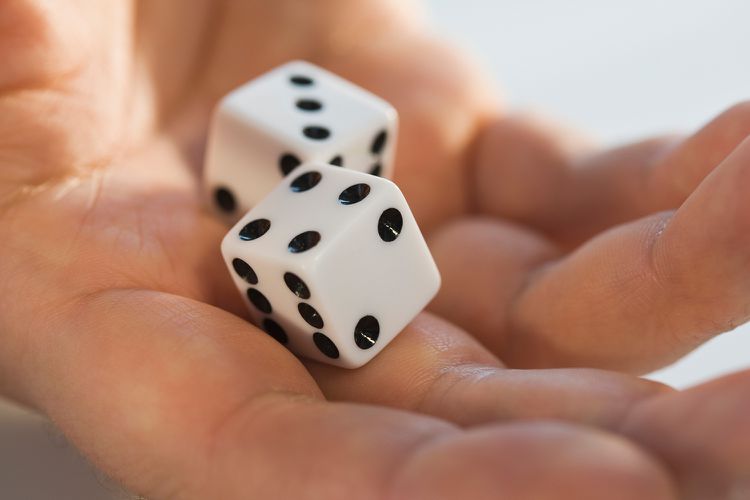
- Even when you know the probabilities, that doesn’t mean you know what is going to happen. e.g. in Backgammon, you roll 2 dice and the possible outcomes of rolling two dice are represented in the table below. The number of total possible outcomes is 36.
. 1 2 3 4 5 6 1 (1, 1) (1, 2) (1, 3) (1, 4) (1, 5) (1, 6) 2 (2, 1) (2, 2) (2, 3) (2, 4) (2, 5) (2, 6) 3 (3, 1) (3, 2) (3, 3) (3, 4) (3, 5) (3, 6) 4 (4, 1) (4, 2) (4, 3) (4, 4) (4, 5) (4, 6) 5 (5, 1) (5, 2) (5, 3) (5, 4) (5, 5) (5, 6) 6 (6, 1) (6, 2) (6, 3) (6, 4) (6, 5) (6, 6)
Total of 7 can happen in 6 different combinations viz. (1 & 6, 2 & 5, 3 & 4, 4 & 3, 5 & 2, 6 & 1). Thus probability is 6/36 = 16.7% For combination total of 6, it is 5 possibilities out of 36, thus probability is 5/36 = 13.89% For total of 2, there is only 1 possibility (1 & 1) or total of 12 also has 1 possibility (6 & 6). Thus probability for these combinations is 1/36 i.e. ~3% and so on and so forth. Thus we know the probability for each combination (most likely, least likely etc.) In spite of this, we still don’t know what’s going to happen. Knowing the probability does not eliminate the uncertainty. - Sometimes the expected value isn’t among the possibilities. e.g. Let’s say, the outcomes are 2, 4, 6, 8 and all are equally likely to happen i.e. each has 25% chance. So the people will bet on expected value as (2×0.25) + (4×0.25) + (6×0.25) + (8×0.25) = 5. But 5 is not even an outcome that can happen, so this is the fallacy of expected value.
- Another problem with expected value can be explained as below. Let’s say, outcome A) has higher expected value, but risk of total loss; and outcome B) has lower expected value, but no risk of total loss. In this case, we select outcome B) over outcome A) in spite of lower expected value.
What is the relationship between risk and asset quality?
Usually, it is assumed that high quality assets are less risky. People assume that large cap stocks are less risky than small cap stocks. But risk is NOT a function of asset quality.
- A high quality asset can be priced so high that it’s risky.
- On the other hand, a low-quality asset can be cheap enough to be safe.
- It’s not what you buy, it’s what you pay. Investment success doesn’t come from buying good things, but from buying things well.
To conclude, risk in investments is something that needs to be managed and controlled, not avoided.
Leave a Reply